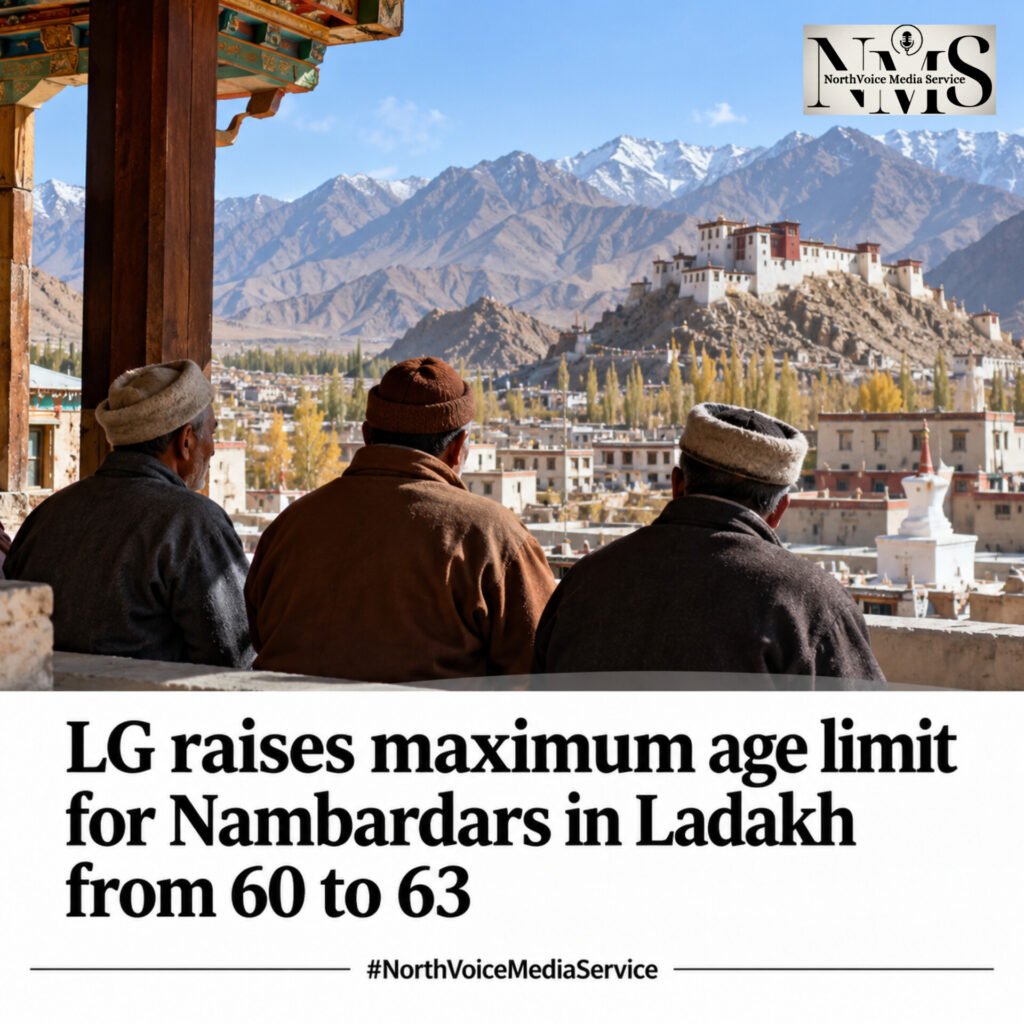
SRINAGAR, October 9: Lieutenant Governor of Ladakh V K Saxena has raised the maximum age limit for Nambardars in the Union Territory from 60 to 63 years, fulfilling a long-standing demand of village heads across the region.The decision was announced on Friday following a request made by the president of the All Ladakh Goba Association during an interaction between the Lieutenant Governor and Nambardars from different parts of Ladakh at Lok Niwas on October 3, according to an official statement.The association had sought the removal of the existing age ceiling, arguing that Nambardars should be allowed to continue serving as long as they remain capable of discharging their responsibilities and retain the confidence and support of the public.Under the Jammu and Kashmir Lambardari Rules, 1980, the tenure of a Lambardar is five years or until the age of 60, whichever comes earlier. Exercising his powers under Section 6 of the Jammu and Kashmir Lambardari Act, 1972, read with Rule 16 of the 1980 rules, the Lieutenant Governor has now increased the maximum age limit to 63 years while retaining the existing five-year tenure.The revision is aimed at ensuring continuity in grassroots administration, preserving institutional experience and traditional knowledge, and facilitating smoother administrative transitions, particularly in remote villages and geographically challenging areas of Ladakh.Explaining the importance of the decision, Saxena said Nambardars play a significant role in maintaining a direct link between the administration and the people, especially in remote and difficult-to-access areas of the Union Territory.“Nambardars are an important link between the administration and the people, particularly in Ladakh’s remote and geographically challenging areas. Their experience, knowledge of local traditions, and close connection with their communities are valuable assets,” the Lieutenant Governor said.He added that the revision of the age limit would help maintain continuity in grassroots governance and allow experienced community leaders to continue contributing to local administration.Nambardars, also known as Gobas, play an important role in connecting local communities with the administration. Their familiarity with village-level issues, traditional practices and public concerns helps strengthen last-mile governance and supports the effective delivery of government services and welfare schemes.The role is particularly significant in Ladakh, where difficult terrain, scattered settlements and geographical challenges can make administrative outreach more demanding. Experienced village heads often help authorities understand local needs and maintain communication with residents.The latest decision follows an earlier initiative by the Lieutenant Governor to increase the monthly honorarium of Nambardars from ₹1,500 to ₹5,000 in recognition of their contribution to local administration.The increase in honorarium was intended to acknowledge the responsibilities shouldered by Nambardars and their role in facilitating coordination between the government and local communities.With the maximum age limit now extended to 63 years, the administration expects experienced Nambardars to continue serving their communities for a longer period, subject to their ability to perform their duties and the applicable rules.The decision marks a significant administrative change for village heads in Ladakh, addressing a long-standing demand while seeking to preserve experience and continuity in local governance.
Leave a Reply